Buying Guides
How to Choose a Kitchen Pull-Out Basket for Wholesale & OEM Projects
A practical guide for importers, distributors and kitchen hardware buyers on choosing pull-out baskets, including size, material, slides, load capacity, installation and OEM customization.
How to Choose a Kitchen Pull-Out Basket for Wholesale & OEM Projects
Kitchen pull-out baskets are widely used in modern kitchen cabinets because they make storage easier and improve the use of cabinet space.
For importers, distributors, cabinet manufacturers and kitchen hardware brands, however, choosing the right pull-out basket involves much more than selecting a design from a catalog.
Cabinet size, basket dimensions, material, slide quality, load capacity, surface finish and installation method can all affect the final product performance.
Before placing a wholesale or OEM order, here are several important points buyers should consider.
1. Confirm the Cabinet Size First
Cabinet compatibility is one of the first things to check when sourcing pull-out baskets.
Different markets use different cabinet systems and dimensions.
Before selecting a model, buyers should confirm:
- Cabinet width
- Internal cabinet dimensions
- Cabinet depth
- Available installation height
- Door configuration
- Installation clearance
A pull-out basket may look suitable in a catalog but still cause installation problems if the dimensions do not match the cabinet.
For wholesale projects, confirming cabinet specifications before production can help reduce installation complaints later.
2. Check the Basket Material
Material affects appearance, durability and product positioning.
Pull-out baskets can be produced with different metal materials and surface treatments depending on the target market and required price level.
When comparing products, buyers should confirm the material used for:
- Basket frame
- Wire structure
- Mounting components
- Connecting parts
- Slides
Material specifications should be clearly confirmed before mass production, especially for private-label and long-term purchasing projects.
3. Pay Attention to the Slide System
The slide is one of the most important components of a pull-out basket.
A good basket should move smoothly during opening and closing and remain stable when carrying kitchen items.
Buyers should evaluate:
- Slide type
- Extension length
- Load capacity
- Smoothness
- Stability
- Soft-close options
- Installation method
For products that are used frequently, slide performance can have a major impact on the customer's overall experience.
4. Evaluate Load Capacity
Pull-out baskets may be used for bottles, food containers, cookware, cleaning products or other kitchen items.
This means load capacity should match the intended application.
A basket designed for lightweight storage may require a different structure from one designed to carry bottles or heavier kitchen products.
For B2B buyers, it is useful to understand both the basket structure and the recommended working load before placing an order.
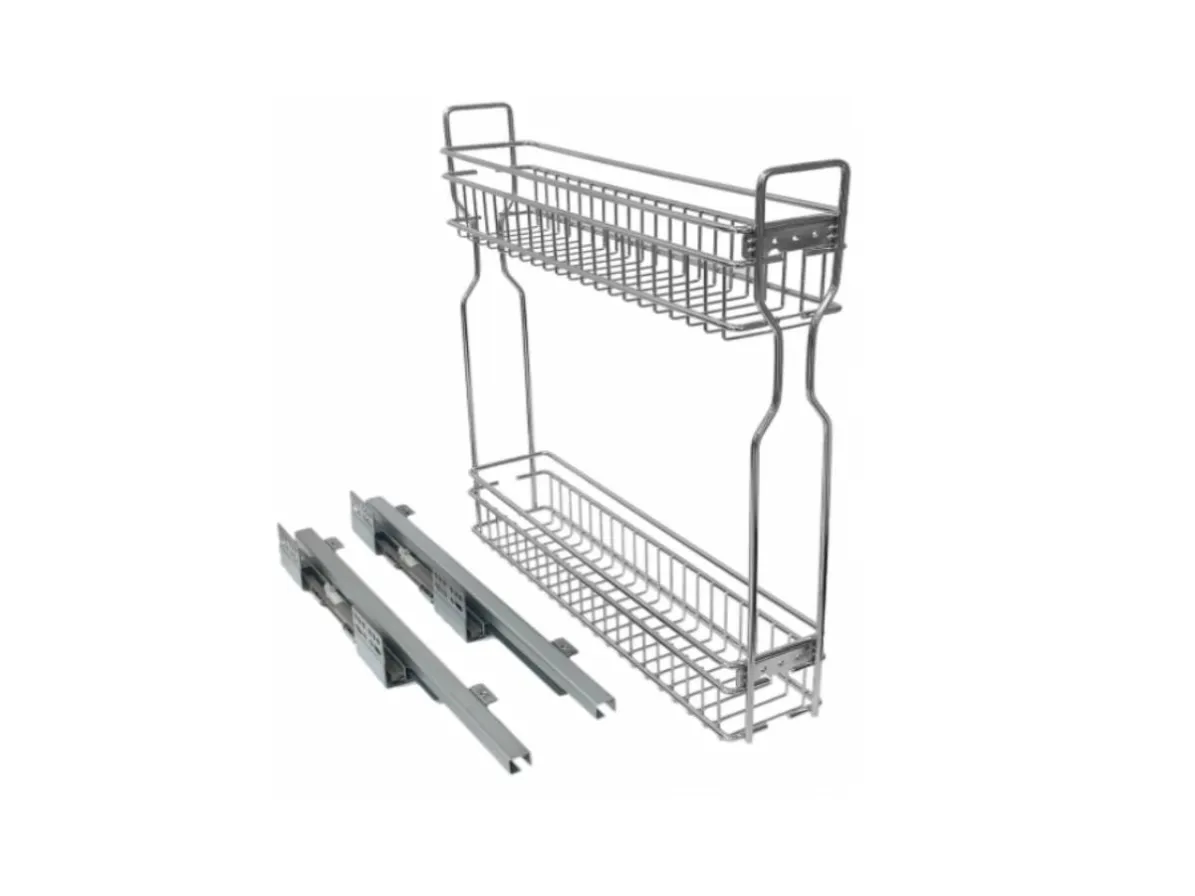
5. Check the Basket Layout
The internal layout should match how the final customer will actually use the product.
Depending on the design, buyers may need to consider:
- Number of storage levels
- Basket height
- Wire spacing
- Bottle storage
- Side protection
- Item accessibility
- Available storage capacity
For narrow cabinet pull-out baskets, efficient use of vertical space is especially important.
A practical layout can improve storage capacity without increasing the cabinet footprint.
6. Evaluate the Surface Finish
Surface treatment affects both appearance and maintenance.
Depending on the product range, different finishes may be selected to match cabinet hardware styles and market preferences.
Buyers should consider:
- Surface consistency
- Corrosion resistance
- Cleaning requirements
- Scratch resistance
- Appearance after long-term use
For distributors and brands, consistent surface quality between different production batches is also important.
7. Consider Installation Efficiency
Installation is often overlooked during product selection.
For cabinet manufacturers, distributors and project customers, an easier installation system can reduce labor time and after-sales problems.
Before confirming a model, buyers should check:
- Mounting position
- Number of installation components
- Slide fixing method
- Adjustment options
- Installation instructions
- Required cabinet preparation
Clear installation information is especially important when the product will be sold in different countries.
8. Check Packaging and Shipping Efficiency
For wholesale buyers, packaging is part of the product cost.
A pull-out basket with inefficient packaging may increase freight costs, storage space and the risk of damage during transportation.
Buyers should confirm:
- Individual packaging method
- Carton dimensions
- Units per carton
- Product protection
- Container loading quantity
- Label and barcode requirements
For large-volume orders, packaging optimization can help improve overall logistics efficiency.
9. Confirm OEM and Customization Options
Different markets may require different basket sizes, finishes or accessories.
For this reason, OEM and ODM capability can be important for importers and kitchen hardware brands.
Possible customization options may include:
- Basket dimensions
- Wire structure
- Surface finish
- Slide system
- Accessories
- Logo
- Packaging
- Labels
- Instruction manuals
Providing clear project requirements at the beginning can help suppliers evaluate feasibility, tooling requirements, MOQ and production lead time more accurately.
10. Evaluate the Supplier Beyond the Sample
A good sample is only the first step.
For long-term B2B cooperation, buyers also need to know whether the supplier can maintain stable specifications during mass production.
Important factors include:
- Production capability
- Quality control
- Material consistency
- Slide assembly
- Welding quality
- Surface finishing
- Packaging control
- Lead time
- Communication efficiency
- OEM capability
The lowest quotation does not always produce the lowest total purchasing cost.
Stable production and fewer after-sales problems can be more important for long-term wholesale business.
Choosing the Right Pull-Out Basket Supplier
There is no single pull-out basket suitable for every kitchen market.
The right product depends on cabinet dimensions, target customers, required load capacity, preferred finish, price positioning and sales channel.
Importers, distributors and kitchen hardware brands should therefore compare products based on the complete application rather than appearance alone.
If you are sourcing kitchen pull-out baskets for wholesale, distribution, cabinet projects or OEM programs, preparing your cabinet dimensions, target quantity, required finish and customization requirements before requesting a quotation can make supplier evaluation much more efficient.